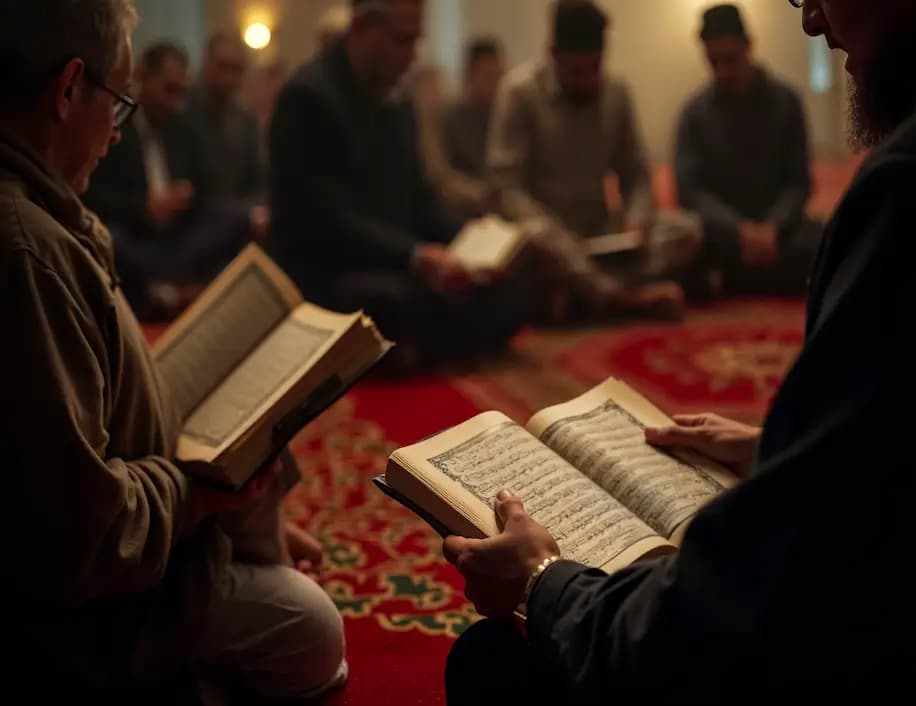

Building a Daily Learning Routine Around Your Deen
Build a daily Islamic learning routine by protecting one consistent time slot, starting with a simple fifteen-minute structure (Quran plus a short lesson), and following one rule:...
Practical study habits, routines and motivation for seeking knowledge consistently around a busy life.
Build a daily Islamic learning routine by protecting one consistent time slot, starting with a simple fifteen-minute structure (Quran plus a short lesson), and following one rule:...
To seek barakah in your studies, pair sincere effort with reliance on Allah: begin with the intention of seeking knowledge for His sake, make du'a for beneficial knowledge and unde...
Seeking knowledge is among the most virtuous acts in Islam: Allah raises the ranks of those who have knowledge, the Prophet (peace be upon him) said the path to knowledge is a path...
To recover a broken learning routine, drop the guilt and restart immediately at a smaller level than before — make the comeback portion tiny so it's easy to resume. Don't try to 'm...
Effective memory techniques for students of knowledge include spaced repetition (reviewing just before you forget), active recall (testing yourself rather than rereading), teaching...
To balance dunya and seeking knowledge, stop treating them as rivals and integrate them: make small, protected time for learning a permanent fixture (not an afterthought), use the...
Consistency beats intensity because small daily learning compounds and embeds in long-term memory, while intense bursts burn out and fade. A few minutes every day outperforms occas...
To set realistic Islamic learning goals, make them specific and measurable (e.g. 'read one page of tafseer daily' or 'learn to recite Surah Al-Mulk with Tajweed in three months'),...
To overcome procrastination in seeking knowledge, shrink the task until starting feels trivial (open the book, read one page), remove friction by preparing materials in advance, an...
To take effective notes in Islamic studies, capture the main points in your own words rather than transcribing everything, record evidences (Quran and hadith references) precisely,...
The best time to study is whenever you can be consistent, but the period after Fajr is especially valuable — the mind is fresh, distractions are fewest, and the Prophet (peace be u...
To study Islam while working full-time, claim the small reliable windows you already have — the commute, lunch break, after Fajr, or before sleep — and protect one as a learning sl...
To stay consistent in seeking knowledge, rely on systems rather than motivation: protect a small fixed daily slot, keep the daily amount tiny enough that you can't fail, attach lea...