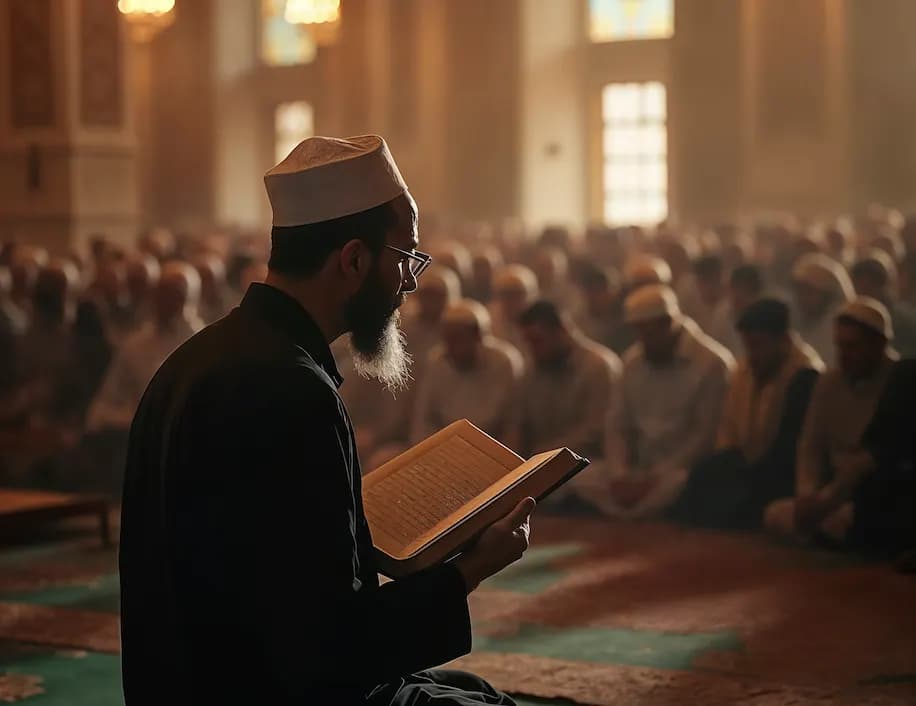
Every correct recitation begins with the Makharij — the precise points in the mouth and throat from which each letter is produced.
Key Takeaways
- Makharij are the points where each Arabic letter is produced.
- There are five main regions: oral cavity, throat, tongue, lips and nasal passage.
- These divide into roughly seventeen specific articulation points.
- Correct articulation is the foundation of all correct recitation.
- Makharij must be heard and corrected by a teacher, not learned from a chart alone.
Before any rule of Tajweed can be applied, each letter has to be produced from the right place. That is what Makharij al-Huruf are — and why they come first in any serious study of recitation.
The five main regions
- Al-Jawf — the empty space of the mouth and throat (the long vowels).
- Al-Halq — the throat (three points producing letters like the hamzah, ha, ayn, ha, kha, ghayn).
- Al-Lisan — the tongue (the largest group, with many letters).
- Ash-Shafatan — the lips (ba, mim, waw, fa).
- Al-Khayshum — the nasal passage (the ghunnah, nasal sound).
Why it must be heard
Letters such as the heavy and light forms, and the throat letters, have no exact English equivalent. A chart can show you where, but only a teacher can tell you whether the sound you are producing is right — which is why Makharij is taught aloud, with correction.
Frequently Asked Questions
What are Makharij al-Huruf?+
They are the articulation points — the precise locations in the mouth, throat, lips and nasal passage — from which each Arabic letter is correctly produced. Getting the makhraj right is what makes a letter sound correct.
How many Makharij are there?+
Scholars most commonly count five main regions divided into seventeen specific points, though some count sixteen or fourteen depending on the method.
Can I learn Makharij on my own?+
You can learn the theory, but the sounds must be modelled and corrected by a qualified teacher. Several Arabic letters have no English equivalent and are easy to mispronounce without feedback.
Sources & Further Reading
Islamic Education Editorial Team
Reviewed by verified teachers (Quran, Arabic and Islamic studies) on the Talib Alillm platform.