
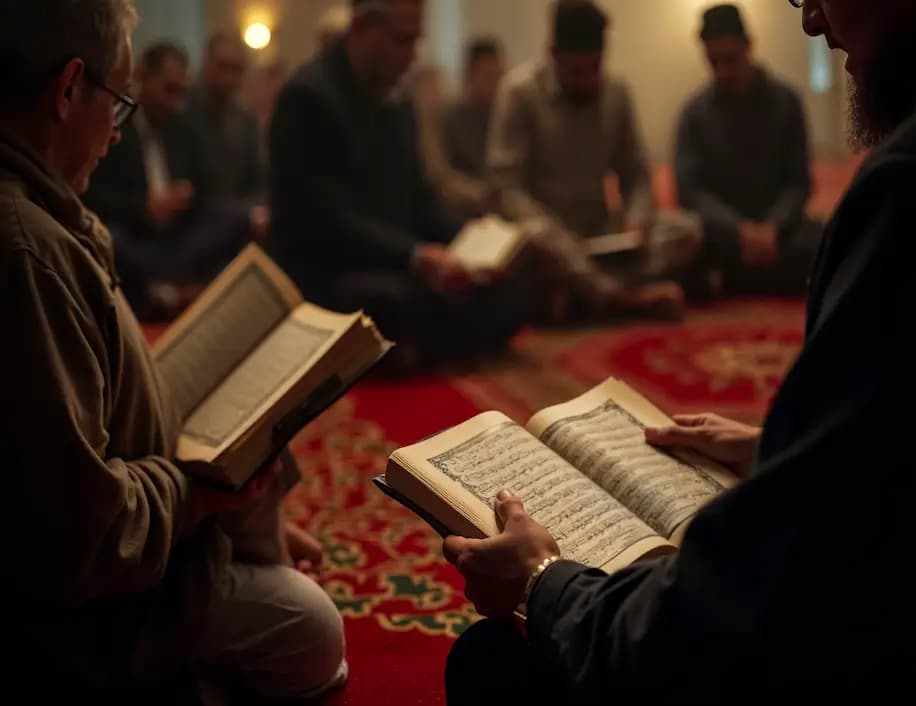
Tajweed is for every Muslim who recites the Quran, not just advanced students. Here is what it is, why it matters, and exactly how to begin.
Key Takeaways
- Tajweed means reciting the Quran correctly — the rules of pronunciation and flow extracted from how the Prophet ﷺ recited.
- Its foundations are for every reciter, not only scholars and Huffaz.
- Reciting with basic correctness is an individual duty (fard ayn); mastering the theory is a communal duty (fard kifayah).
- Begin with the articulation points of letters (Makharij), then Noon Sakinah rules, Meem Sakinah, and Madd.
- Tajweed is an oral tradition — you cannot learn it from a book alone; a teacher must hear and correct you.
Tajweed is sometimes spoken about as an advanced discipline reserved for Quran teachers and Huffaz. In reality, its foundations are accessible to everyone and directly relevant to every Muslim who recites the Quran, regardless of their level. If you pray, you recite — and if you recite, Tajweed concerns you.
What Tajweed actually is
The word Tajweed comes from the Arabic root meaning to improve or to do well. In recitation, it refers to the rules governing:
- How each letter of the Arabic alphabet is correctly pronounced.
- How letters interact with each other when they appear in sequence.
- How the rhythm, flow and length of sounds are maintained.
- How the voice should be used to honour the words being recited.
“And recite the Quran with measured, distinct recitation.”
— Surah Al-Muzzammil, 73:4
These rules are not later inventions. They were extracted from the way the Prophet Muhammad (peace be upon him) himself recited the Quran, as taught to him by the Angel Jibril — and passed down, mouth to ear, in an unbroken chain ever since.
Is Tajweed obligatory?
Scholars distinguish between two levels, and the distinction is reassuring for beginners:
- Fard Kifayah (communal obligation): knowing the rules theoretically, fulfilled if enough people in a community learn them.
- Fard Ayn (individual obligation): reciting with the basic correctness that Tajweed enables. This applies to every Muslim.
You do not need to become a Tajweed scholar. But you do have a responsibility to recite as correctly as you are able to, and to actively seek to improve. The duty is on the effort, not on instant perfection.
“You do not need to master every rule of Tajweed. You need to recite with the care and precision that the words of Allah deserve.”
The essential rules to start with
For a beginner, learn these in order — each one builds on the last:
- Makharij al-Huruf: the exit points of the letters. Correct pronunciation comes before anything else.
- Noon Sakinah and Tanween: including the four rules of Izhar, Idgham, Iqlab and Ikhfa.
- Meem Sakinah: the rules governing a silent Meem before other letters.
- Madd: the rules for lengthening vowel sounds, with their various types and durations.
A qualified teacher will sequence these for your level and ensure each rule is embedded before moving to the next. Trying to learn them from a chart, all at once, is how most self-learners stall.
Why you cannot learn Tajweed from a book alone
Unlike almost every other Islamic subject, Tajweed is an oral tradition. It must be:
- Heard from a qualified teacher who recites it correctly themselves.
- Modelled aloud, so you can hear what correct recitation sounds like in practice.
- Corrected in real time as you recite, so that errors do not become habits.
Books and recordings are useful supplements. But only a live teacher can hear your specific errors and correct them. This is non-negotiable, and it is the single most important investment you can make in your recitation.
Tajweed is a lifelong pursuit, but it begins with a single session. Find a qualified teacher, start with the letters, and give the Quran the recitation it deserves. Every improvement is an act of reverence for the words of Allah.
Frequently Asked Questions
What is Tajweed?+
Tajweed is the set of rules governing the correct pronunciation of the Quran: how each letter is articulated, how letters interact in sequence, and how the rhythm and length of sounds are maintained. The word comes from an Arabic root meaning 'to improve' or 'to do well'.
Is Tajweed obligatory?+
Scholars distinguish two levels. Knowing the rules in theory is a communal obligation (fard kifayah), fulfilled if enough people in a community learn them. Reciting with the basic correctness that Tajweed enables — pronouncing letters and words accurately — is an individual obligation (fard ayn) on every Muslim, to the best of their ability.
Which Tajweed rules should a beginner learn first?+
Start in this order: the articulation points of the letters (Makharij al-Huruf), then the rules of Noon Sakinah and Tanween (Izhar, Idgham, Iqlab, Ikhfa), then Meem Sakinah, then the rules of Madd (elongation). A qualified teacher will sequence these to your level.
Can I learn Tajweed from a book or app?+
Books, apps and recordings are useful supplements, but Tajweed is fundamentally an oral tradition. It must be heard from a qualified reciter and corrected in real time as you recite, so that errors do not become permanent habits. A live teacher is essential.
How long does it take to learn Tajweed?+
It varies with starting level and practice, but most beginners can grasp and apply the essential rules within several months of regular lessons. Tajweed is then refined over a lifetime — even accomplished reciters keep improving.
Sources & Further Reading
Islamic Education Editorial Team
Reviewed by verified teachers (Quran, Arabic and Islamic studies) on the Talib Alillm platform.